
I've always had an affinity for big art. Scale. Large-scale. The huge colour-blocked canvases of Barnett Newman, where fields of pigment stretch so wide that your peripheral vision dissolves and you're swallowed by colour. The massive public art pieces of Louise Bourgeois, her spiders looming over plazas like ancient guardians, simultaneously maternal and menacing. Henry Moore's beyond-human-scale sculptures, those reclining figures that marry landscape and body so completely you can't tell where the earth ends and the figure begins. There's something about work that exceeds your frame of vision that forces you into your body, makes you aware of your own scale against something monumental. Another important consideration in my love for the big is architecture.
Gaudí, with his cathedral that has been under construction for over a century and still reaches toward God. Frank Lloyd Wright, whose Fallingwater seems to grow from the rockface as though the building had always been there. Moshe Safdie, whose Habitat 67 reimagined what a home could be by stacking concrete cubes into a village in the sky. And by far my most admired architect: Douglas Cardinal. Accessibility plays a role in this admiration (all his major works are here in Canada, within reach for someone who drives this country repeatedly) but that's not the reason I keep returning to his work. His buildings carry an organic, living quality. They are celebrations of nature: structures that do not merely emerge from the land but are part of the land itself.
I remember seeing my first Cardinal in St-Albert, Alberta. A couple of friends had recently moved there from Edmonton to settle down, and we met up with them during a beautiful summer's day at St-Albert's local farmers' market. It was located at the centre of town, just along Sturgeon River, one of Cardinal's earliest built projects. Trent and I were jaw-dropped when we saw St. Albert Place. The building defied every expectation I had of the kind of municipal architecture that usually means metal panelling and rectangular pragmatism. Instead, here were sweeping curves of glass and brick seeming to ripple like a river caught mid-current. The complex housed a library, a theatre and other city cultural facilities but from outside it read as a single, continuous paint stroke. Now every time we visit, I like to drive by to catch a glimpse (as I'm writing this, in St-Albert actually, it's under some construction so the beautiful glass façade isn't visible).
What is it about Cardinal that captures me so completely? Here's where my fine art education comes out. I can't help but read Cardinal's buildings the way I was taught to read paintings and sculptures: formally, aesthetically, attending to composition and material and the way form shapes experience.
Walls bend, roofs undulate, floor plans flow like water finding its path. No right angles. Cardinal evolved his designs "from the inside out," beginning with experience and letting exterior form follow. His buildings are overwhelmingly civic, deeply responsive to place. He engages with the people who will inhabit a space, letting their needs and stories shape it. At the First Nations University in Regina, circular forms echo ceremonial traditions. At the Canadian Museum of History in Gatineau, two immense curving wings embrace the Ottawa River, framing Parliament Hill as a deliberate gesture of dialogue between Indigenous and settler histories. This puts me back in mind of when I conducted my master's thesis and ran a co-design process with participants. Looking back, participative design is the most fulfilling but done wrong can be very destructive. It's also very difficult to include a collaborative multi-participant project over a long span of time (mine was merely 18 months—imagine an architectural project).
Natural materials like limestone, granite, wood and copper weather and deepen with age, so the building keeps evolving after construction. Light is a primary material. Skylights trace ceiling curves, windows follow organic wall lines, interior light shifts through the day so no two visits are the same. There's a warmth to his interiors that contradicts the monumentality of the exteriors. You approach something so big, and inside you find intimacy. It's the same feeling I get standing in front of a Newman canvas, enormous and impersonal in scale, and yet producing a strangely private, almost devotional response.
Living a nomadic lifestyle and having crossed the country many times made me want to discover as many Cardinals as possible. Travel through Canada to see all of them if I could.
The geography of Cardinal's work matters. These aren't buildings that could be airlifted to any plot of land. Each one responds to its specific site (the river in Gatineau, the prairies of Regina, the civic heart of St-Albert). I'm compelled to map out his buildings across the country, tracing a journey that follows the thread of one architect's vision as it stretches from small-town Alberta to the national capital.
The first step to this journey is to create a map of all the Cardinals built. I couldn't find an existing one online, so I decided to create my own (I've only mapped out 25 so far).
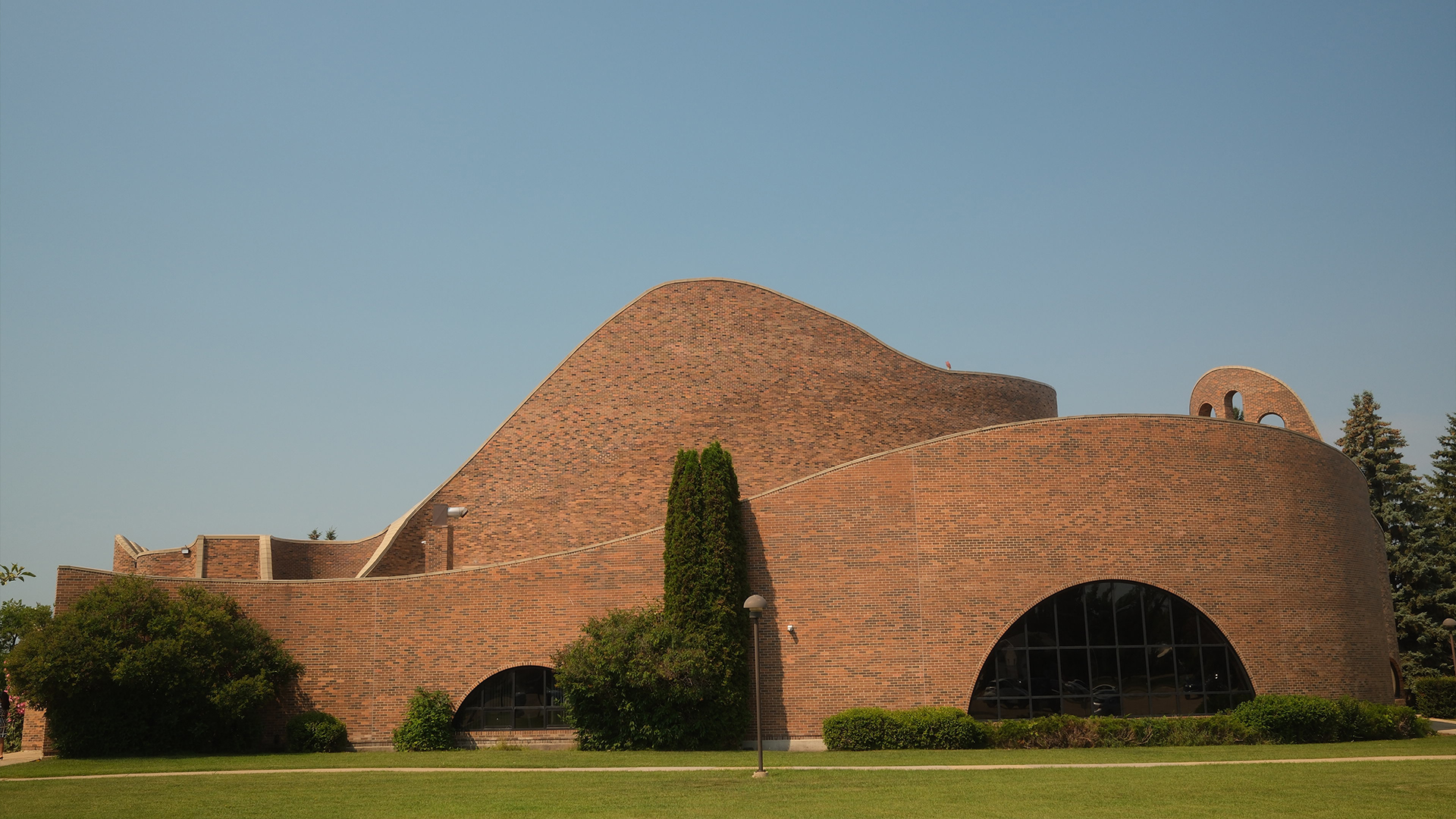
Multiple locations across five provinces and a couple American states. We'll start at St. Mary's Parish in Red Deer, his first built work, completed in 1968. From there, the route spreads outward. We visited on a sunny Sunday at noon (2026/07/26). Sunday mass was just ending, the parking lot and neighbouring streets full, cars spilling into the elementary school lot across the street, anywhere to get to church. We found a spot for our big van in the residential neighbourhood on the back side of the building. The back door was open, so we saw my opportunity to see the inside before it closed for the day. We made our way past people swarming out on their way back to their cars, exchanging friendly good afternoons and good days. As I entered the curvy passageway, I was washed by natural light pouring from light wells in the roof. They were centred in the room, illuminating the altar where the priest would conduct mass. Pews circled around the light well and the curved brick wall hugged them all. Even the confessionals were built within the curved frames of the wall. I spent a few minutes standing there as people made their way out, then exited through the front door. An elderly couple noticed we were looking at the building as a visitor, not a practicing churchgoer. I told them I'm a big fan of the architect, and we exchanged some friendly remarks about the building. Outside, Trent and I explored and took many photos. What I love about Cardinal's work is that it allows for abstracted captures. The organic forms of the building remind me of Henry Moore's landscape figures, where forms are abstracted and reduced into really admirable figures meeting human and nature together.
I've driven across Canada many times now, the van loaded up and the Trans-Canada stretching out ahead. And the truth is, I've gotten comfortable pretty much everywhere I go. I know which gas stations have the cheapest diesel between Thunder Bay and Sault Ste. Marie. I know where to pull over around Lake Superior when the light hits the water just right. I know the stretch of prairie east of Regina where the sky gets so wide you feel like you might float off the road. I've developed a comfort, a kind of easy fluency with the geography of this country that comes from repetition and familiarity.
But comfort isn't the same as relationship. Comfort is what happens when a place stops surprising you. Relationship is what happens when you let a place keep surprising you, when you stay attentive, when you learn its specifics rather than just its rest stops, when you ask not just *where am I* but *what is this place?* As a child, either on roadtrips or during quick drives to the Rockies, my dad would always know and acknowledge who’s land we were on. Driving toward Banff from Calgary, he'd mention the Nakoda. East of Calgary, the Stoney Plains. The Siksika, the Tsuut'ina Nation. I've taken that habit with me now when I drive cross-country. I ask myself: what treaty am I on? What are the natural landmarks that mark this place? Whose reserve am I driving through? Those questions keep a place alive, keep it from becoming scenery. There's a difference between passing through and being present, between knowing a route and knowing a place.
This is the deeper aim: to use this pursuit as a structure for my own relationship-building. Each Cardinal site gives me a reason to stop somewhere I might otherwise drive past. Standing inside St. Mary's, washed in that light, hugged by those walls, I understood that each stop is an opportunity to be somewhere specific, to notice what Cardinal noticed when he built there, to ask what the land was saying and what it might tell me if I'm quiet enough to listen.
I hope this project gives me a practice of seeing I can carry with me long after I've left the parking lot. A way of being in this country that moves beyond comfort toward something deeper and more accountable. The van will still be loaded up, the highway will still stretch out ahead, and I'll still know where the cheap diesel is. But between those familiar waypoints, I'll be stopping and looking. I'll be listening with Cardinal's buildings as my teachers and my excuse. Because the land isn't something I drive on. It's something I'm part of.


studiopumpo.com