
After leaving Cardinal's St. Mary's Church in Red Deer, we drive toward Edmonton before continuing up to Jasper for a friend's wedding. One day in Edmonton means three Cardinal stops: The Grotski Residence in the Capilano neighbourhood, the Telus World of Science (formerly the Edmonton Space Science Centre), and St. Albert Place in the neighbouring town of St. Albert.
Some days ago, I wrote about why I'm doing this. About using these sites as anchors for learning how to be present in places I'd otherwise speed through. Now I'm living that experiment. Each stop asks the same question in slightly different voices: what does it mean to arrive somewhere instead of merely passing through? I'm still figuring out the answer.
We wake up parked in a ravine adjacent parking lot where we spent the night. Morning brings downtown and river views through the van windows, some trickling rain on the roof, and we head for a ravine trail. Edmonton's ravines are full of small trails perfect for Soba to burn off his puppy energy. We spend time training and feeding him before tackling our first Cardinal stop. This is where my theory/research brain meets the asphalt. The van becomes not just our way to get around, work, and live, but a vessel for my expanding patience. And I need it. I'm inherently not a patient person. The minute I get something crossed off my list, I move on quickly. But this experience is teaching me that arriving doesn't happen when you pull over but rather when you let yourself be somewhere long enough for the place to reveal something to you.
The Grotski Residence sits not too far from our overnight spot on the east side of town, the closest place to begin. This residence represents one of Cardinal's few single-family homes. Originally built in the mid-century, Cardinal's work on the house involves an addition and renovation to the original structure. As one of Edmonton's neighbourhoods that directly overlooks the North Saskatchewan River, the location gives opportunity and inspiration for his distinct nature-based style.
Driving up to the residence, I let out a small squeal when I see the chimney. Made of red brick, sloping onto the ground and rising into the sky in a curved line. Floor-to-ceiling windows, large wooden beams. Trent makes a comment: "Would you live in Edmonton if you could live in a Douglas Cardinal house?" Yes, of course I would. But the problem would be that I'd never want to leave. I'd stay inside and at most visit the river. Everybody would have to come to me because why would I ever want to leave such a beautiful space? Trent goes out to take a few pictures from the outside without looking like a creep (the house is an official personal residence, so we don't want to intrude).
Standing in the driveway, I think about what I wrote before. About each site teaching me how to read a landscape. Here, this property isn't a museum or a civic building but someone's actual home. My pilgrimage hits a boundary, and that's okay. There's a humility in keeping distance, in appreciating without consuming. Cardinal designed for belonging and integration, not spectacle. So I stand back. I look. I don't touch.
A drive through Edmonton means one absolute thing to me: a stop at Remedy Cafe. Having moved away from Montreal a couple months ago means I miss my cafe stops. But there's a little bright light in Edmonton on a rainy, windy day at a local Remedy Cafe, where the chai is hot and spicy. Driving from east to west, we stop central for a chai and a big jug of their homemade concentrate, so that when we're on the road, I can make chai from the van.
Now, including cheap diesel stations and highway rest stops, the cafe becomes another kind of point. It’s a moment to slow down, taste something local, collect warmth for the next stretch. Small stops like this are what make a place feel like a place.
Not too far on the west side, we find the Edmonton Space Science Centre, now renamed the Telus World of Science. Who knows why they've renamed the Alberta science centres to Telus-branded World of Science? I've visited this place twice, once with Trent's nephew and the second time with a friend and his kids. In 1992 and 2009, additions were built to Cardinal's building (very different looks and feel from the original, but somehow they connect in the middle). Picture an awesome (in the science-fiction sense) futuristic shell-shaped spaceship erupting from the ground. It must have been amazing seeing it in its original form, but now when you enter the centre, you're met with this big facade of colourful metal panels, imposing itself on you with a flashy screen in the middle declaring: TEMPORARILY CLOSED (they flooded recently due to excess rain).
If you ignore the addition, you walk around part of the building and enjoy the mix of curve and straight lines directed at you, as if it were ready for launch.
I wrote before about wanting a practice of seeing I could carry with me. Out here, that practice looks like this: me walking silently around the building's landscape, following the curvilinear paths. Nobody's around due to the flooding, and the wind would deter most from being outside today. So it's just me and Trent quietly pontificating on the structure, trading half-formed thoughts about what Cardinal was reaching for here. The additions that now crowd Cardinal's original vision are reminders that everything gets layered, changed, claimed, lost. Things ebb and flow. Even buildings.
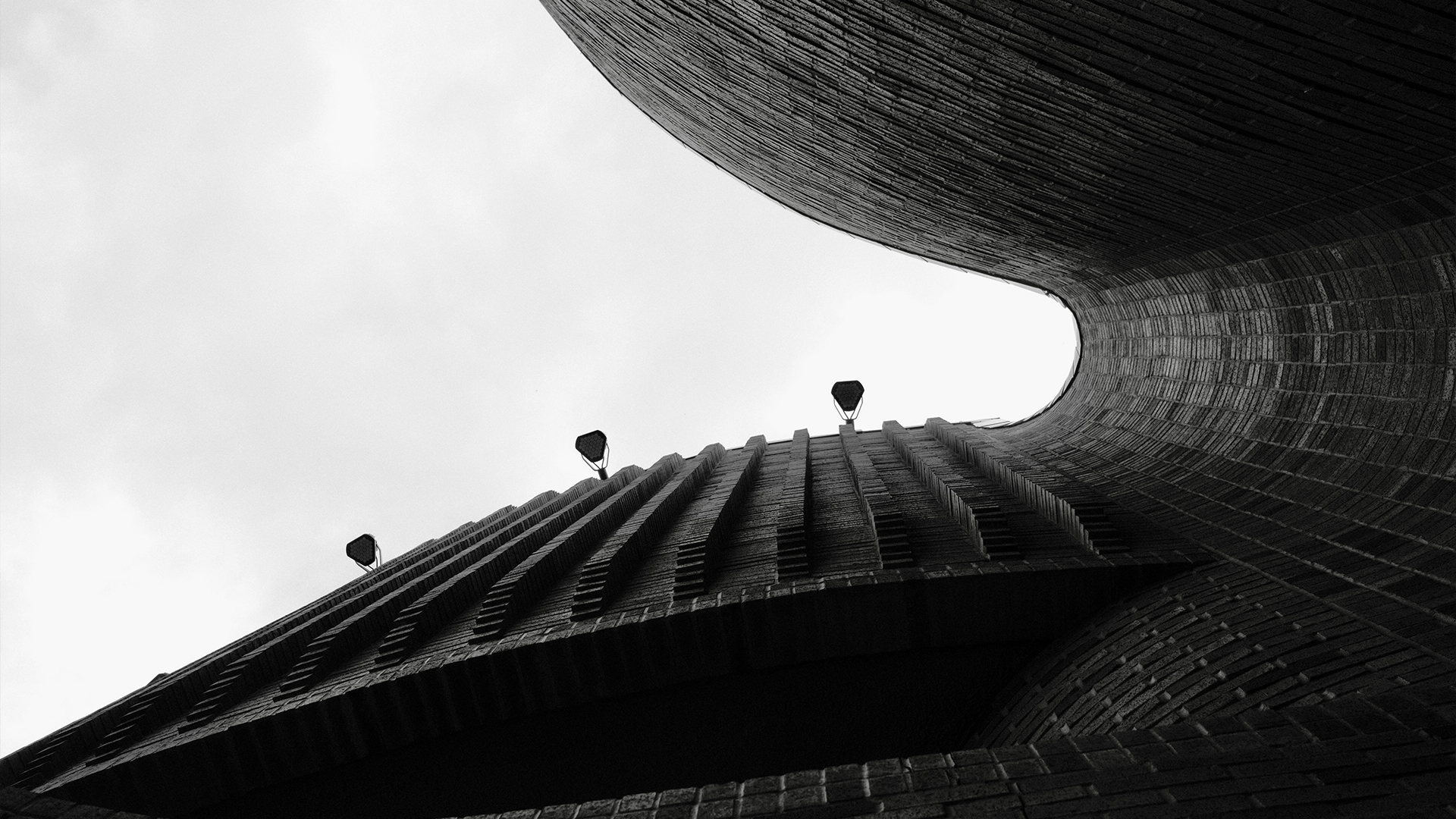
Lastly, we head north-west to St. Albert. We've visited St. Albert Place before, seen its front and gone inside to watch light stream through its large sloping glass ceiling. But this time we intend to see the back side. Mimicking the undulation of the Sturgeon River, which it sits beside, the back features waves in layered balconies. We go up and down, wave around, taking pictures of the curves reflecting in puddles. The pictures we take of the dog as we explore remind us of 90s hip-hop black-and-white album covers. A small thing to laugh about.
Surprisingly, we don't realise how immersive this space is from the outside until now. Its design really makes you feel like you're part of the space, like you're interacting with a large work of art. The outside space feels like an untouched, aged, raw playground of abstract photography. Here, standing on those balconies, I can grasp some of what I was reaching for before. Accountability is most about showing up consistently. It's about returning to the same questions in different locations. It's trusting that if I keep showing up, the answers will either come or stop mattering so much.
The land speaks in textures, light, wind. As The Smiths put it, nature is a language. Cardinal translated it into architecture. I'm learning to translate it in my own way, whatever that turns out to be.


studiopumpo.com