
There's a big rustling in the woods. Something large (bigger than a deer) wrestles into the bushes, cracking branches and moving past leaves as it vanishes quickly, startled. What was that?
We’re parked in Ghost River valley for a few days. We chose a tree-dense spot, framing the van with tall trees that seemed to hug the space, mounds of dirt, and piles of river rocks. A small campfire waited in the centre despite the provincial-wide fire ban. We came here with my parents, who followed us with their own adventure van. The plan was for them to stay for the weekend while we remained for a few extra days. They'd only experienced public land camping once before with us in Porcupine Hills (a weekend where the deer flies were big and carnivorous). They're hoping the bugs won't be as vicious this time.
After trailing down the steep, rocky gravel road that leads to the valley, my dad, Trent, and Soba walked ahead to scout for a better spot further down the path. Soba was electric after spending a whole week in suburbia. He was happy to be back in the woods, free to roam and run as he pleased. A few minutes later, we heard that big rustling sound. It wasn't too far off, so I shouted to get Trent's location—distance and direction-wise. He replied, and soon after appeared out of the bush. He told me directly: Soba found a bear. A small black bear, to be exact.
Trent and I had been wondering all summer what Soba would do if he saw a bear. With how often we're in the woods, we were bound to encounter one eventually. I'd seen plenty in the past, though none this summer so far. Trent's cousin, who worked as a firefighter in the Canadian forests, had told us it's actually safest for both humans and dogs to keep them on leash in the woods. You might not know how your dog would react to a bear. Would it be afraid? Chase it? Try to attack? And dogs tend to be scared themselves, then come back to you which attracts the bear to where you are. That last part is what makes me nervous. I understand leash laws. I'm a stickler about them. My anxious brain can't help it. Soba is always leashed in provincial or national parks. But on crown land, he gets some off-leash freedom. We've trained him with the e-collar for this exact purpose. He recalls reliably every time, despite his prey drive. So we wondered how he'd react if he saw a bear. We both assumed he definitely wouldn't fear it or try to lure it back to us. Soba is fearless. A tough cookie.
We got our questions answered on this trip. Trent explained what happened. As they were walking down the dirt path, Soba went off-trail into the bush. Trent followed, and saw (along with those loud noises) Soba chasing a black bear up a tree in a full sprint. Once the bear climbed up, Soba started barking, just like he used to with squirrels in Montreal city parks. No difference at all. Trent called Soba back from the tree, and they returned to where we'd parked the vans. What a crazy dog I have (this statement comes with a heavy eye roll).
I wasn't surprised Soba did that. It fulfilled the suspicions Trent and I had carried all summer. I was also kind of proud. It made me feel safe in some way. Despite my dog being a crackhead (this term is used commonly in dog training circles to refer to breeds like huskies or malinois), he was confident and agile enough to scare off a bear.
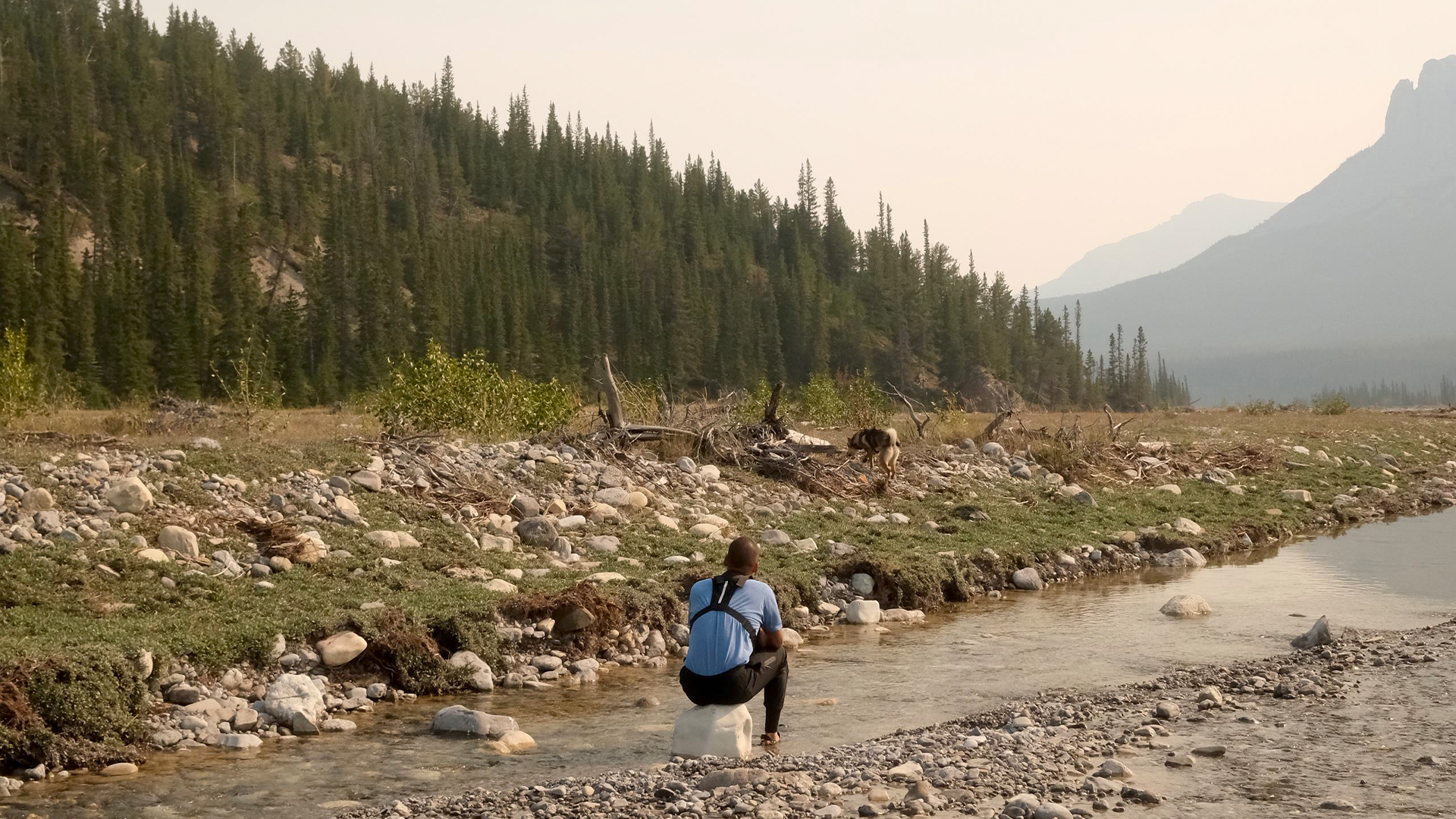
That evening, we had apéro as the sun dipped behind the ridges. My dad’s undesired by others European EDM played dimly from his portable speaker. I watched Soba sampling dirt near the dried-up riverbed, his nose buried in cracked mud where water once flowed. There's something humbling about watching a dog find joy in small things. He didn't worry about anything. He cared about the smell of earth and the freedom to chase whatever moved.
I've had an anxious disposition since moving to Alberta as a six-year-old. Moving to a new place that felt like a new country, a new culture, a new language you had to learn despite not wanting to—it does that to some people. This neurosis of mine made it that I knew I wouldn't be good with having a dog. Trent had always wanted one, and I knew he'd be a very present and dedicated caretaker. So I wasn't worried about Soba not getting his needs met. I was mostly worried about my own emotional capacity to handle the toll having a dog might take. And I was right to be worried.
I struggled when Soba was a puppy. I couldn't build a real relationship with him because I couldn't see past the negatives I saw he brought to my life: lifestyle changes, new routines, different dynamics with my spouse. I learned to accept these things, but it took several months. Vanlife definitely helped me in this regard. Trent trained Soba so well that he's become the perfect dog for this way of living. Central Montreal was a lot for him to handle. It did great things for his socialization with getting used to crowds, loud noises, things like that. But he needed more room and fewer restrictions. Now Soba can roam, and I can be at ease that he'll come back every time, and that he's living his best life.
Most people view their dogs as pets. I've never been able to see Soba in that way. I couldn't figure out what he was to me until now. I see Soba as my dog but mostly as a part of nature. Just like I am. He's not here to be my companion or make me feel good inside or better about myself. He's a reflection of the effort I put into our relationship, a relationship formed on trust and mutual understanding (despite not speaking the same language). When I'm walking with him in a place like Ghost River valley, I see him sniffing around, chasing squirrels, walking in the creek, being as free as can be. I see him completely blend into his environment, like he was meant to be there all along (why he was so comfortable treeing that bear earlier). He's at home. As am I.
I'm still working on my practice of seeing and being in space. And I'm working on seeing myself as part of the environment like Soba is. We as humans in the West have unnaturally separated ourselves so much from our environment. Most people don't consider nature in their daily lives, and they apply that same lack of relationship to their dogs.
I wonder if in part my anxiety has been amplified by sectioning myself away from nature. Living in Quebec, I was raised on a corn farm surrounded by dirt, fresh fruit, and massive maples. I ate from a garden, spent most of my days outside. When we moved to Alberta, going out to nature had to be intentional, and my parents made it so. We dedicated our weekends to the Rockies, just an hour away. If I was sick one week, my mom made sure I'd get a good camping weekend to heal my fever. It worked every time. If I went through a bad breakup, I'd spend the next week cross-country skiing in the mountains. And the pain would leave my body almost instantly.
A couple days later, the weather turned cold, windy, and cloudy, settling into what looked like it would be a quiet day. Not many campers had shown up the night before, so human interaction stayed low (I wasn't complaining). But suddenly in the early afternoon, a helicopter circled overhead, multiple times. Then a second one joined it. We watched as two ambulances and a cop truck came down the hill that leads to civilization, all heading north of the valley. With that many patrols, we wondered if multiple people had gotten hurt. When the ambulances came back, three rangers drove down into the valley instead. Their truck was marked Fish and Wildlife, and we were sure it was a bear attack. They must be coming to warn us. There had been so many bear encounters this season, it wouldn't have surprised me. Trent went to speak with one of the rangers, and we learned they'd actually received a KOS distress signal from someone, as if a vehicle had flipped over and got stuck inside. By the time they searched the area, the signal seemed false. They couldn't find anyone.
Soba rested curled at the foot of the van when the helicopters passed, barely lifting his head. No calculation of danger. He doesn't wait for reassurance before trusting he belongs in this space. He doesn't calculate whether the woods are safe. He just is. The KOS signal that sent rangers scrambling, the bear that charged up a tree, the dried riverbed that once held water. He doesn’t wait for permission to exist in spaces larger than himself. I need to borrow that mentality from him, not for every situation, but for the right ones.
I'm noticing living this lifestyle, I'm happiest out in the boonies, and so is Soba. We're learning, slowly, how to belong. Not as visitors passing through, but as something that was always meant to be part of the wild.


studiopumpo.com