
Jasper was sweet. The Icefields Parkway is not.
Leaving Jasper after a long hike, dumping our black water, and filling up on potable water, we’re burnt out but committed to reaching our next destination. The asphalt hums beneath our tires as we pull onto the Icefields Parkway. Behind us the town fades into pine shadow. Ahead, the road cuts through the wilderness.
With exhaustion pulling at our eyelids, we can’t predict how far we’ll make it tonight. The original plan was to drive all the way to the North Saskatchewan River Crossing onto crown land for some random camping. But that lies further ahead, and it would be a disservice to drive through all this scenery without stopping. This hesitation, stopping to look instead of pressing onward, is a luxury rarely permitted. If mortgage payments and property taxes were looming, we would treat the landscape as scenery to consume quickly. Instead, we measure our time in kilometers and experiences. That sentiment intensifies the further we travel south. The mountains grow progressively larger. Huge. Monumental. We make several stops along the way to truly take it all in, grounding ourselves in the sheer scale of what surrounds us.
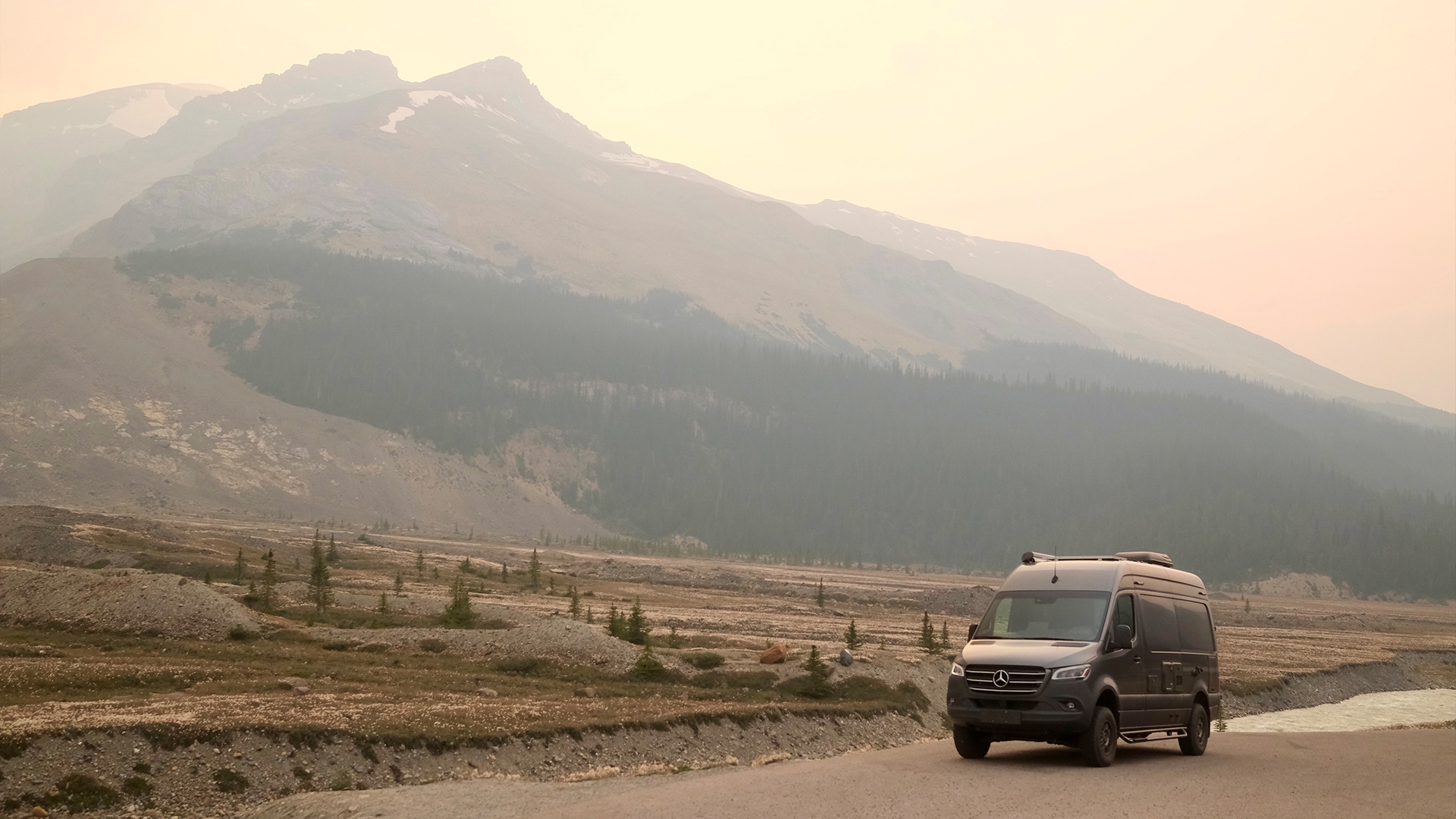
We arrive at the Columbia Icefields, right at the edge where Jasper and Banff National Parks meet. What a sight. The air cools suddenly here. Ten degrees colder than Jasper despite being only 100 kilometers apart. It smells like wet stone and old meltwater. The scent carries mineral sharpness that stings the back of your throat when paired with the lingering smoke of BC wildfires. We also notice on the opposite side of the highway, across from the Athabasca Glacier, a large RV parking lot adjacent to the Columbia Icefields Hotel. That looks like a place for rest. I tell Trent to take a quick left and we swerve into the lot. Just as expected. A paid parking lot where we can stay overnight. The payment machine is broken, so a friendly park ranger approaches and offers to take our money manually—a special encounter with a francophone, always a delight to hear my language spoken in the middle of the Canadian Rockies.
We settle into our spot for the night, overlooking massive slabs of ice until things begin going wrong. We discover the cassette toilet is broken. Here is the reality. Since acquiring the van, I have found myself having conversations most people do not usually discuss unless they also own an RV or converted vehicle. One of these conversations involves toilets and waste disposal. What kind of toilet do you have? How do you get rid of your waste? These are lovely questions we no longer shy away from, and whenever we meet another van lifer on the road, we ask these questions or receive them with mutual curiosity about how others have set up their interiors. There are different types of toilets for those living this lifestyle. You can have a compost toilet, an incinerating toilet, dry toilets, or bucket systems. We have a chemical toilet, otherwise known as a cassette toilet. The cassette removes from the outside and has a hole linking it to the toilet inside the bathroom of our van. They communicate through a valve that opens and closes. This valve broke, which means we cannot seal the opening into the cassette. This is problematic. You can imagine why. Fortunately, there are outhouses at this parking lot.
These questions about waste never feel embarrassing anymore. On the contrary, they seem to function as initiation rites. Asking about someone's toilet setup is the van lifer equivalent of asking about someone's degree or job title. It signals shared sacrifice and a willingness to trade conventional comfort for unconventional freedom. We have all signed the same unwritten contract: accept the smell of chemicals, the anxiety of finding disposal stations, all in exchange for waking up where other people vacation.
The next day, we wake early for a short hike up to the icefields. We drive down a small gravel road to reach the designated parking lot, arriving before the tourists. Dust hangs in the air behind our van where we parked. The crunch of boots on rock fills the silence between footfalls. We take countless photographs and also sit with how much the glacier has receded over the years. The loss is significant. From when my family first migrated west and visited this place in 2006 until now, the glacier has lost several meters of ice (if only I could show you how much). I can only imagine how much more it will recede during my lifetime.
We continue our trek south, finding a popular trailhead at Parker Ridge to park at for the workday. This location also has outhouses. We spend a few minutes setting up laptops, facing the ridge instead of a cubicle. It looks like paradise. The reality is a screen glare from the sun, the hum of a fan struggling against wildfire smoke, and notifications demanding immediate attention regardless of the glacier outside the window. We can be anywhere, yet we remain tethered to deadlines, emails, and the expectation of availability. It’s more like we’re carrying the grind with us rather than truly escaping it, unpacking our screens wherever the road allows.
Once the work finishes, we drive south, only to realize shortly after leaving that the tire pressure in our rear passenger-side tire is dropping drastically. Trent pulls over to the paved shoulder. He steps out of the van to inspect the tire and returns. We have a leak, he says, his lips pierced. He describes the damage, explaining that the rock most likely came from the gravel road leading down to the icefields. It jammed itself right in the center of our tire. Luckily, it will be patchable. What do we do now? Let us change the tire.
Mercedes Sprinters come equipped with a toolkit for situations like this under the passenger seat. We pull everything out, only to discover as Trent brings the wrench to the lug nuts that the wrench doesn’t fit. Our factory kit doesn’t accommodate our aftermarket wheels. We can’t loosen the nuts to swap the tire. The wrench doesn't fit. In that suspended second, the illusion of self-reliance shatters. We built our lives on the premise of independence, packing tools and skills into forty square feet of vehicle space. Yet when a component like this fails, we discover how deeply dependent we remain. On strangers with spare parts, on highways leading to civilization, on fathers willing to drop everything. Every advantage of freedom in this lifestyle carries a vulnerability. The van grants mobility, but mobility means distance from safety nets others take for granted.
In the middle of nowhere, on the Icefields Parkway. There are no garages, no mechanics, no highway rescue. You must find your own solution. I call my dad in semi-panic and explain the situation. He tells me to make it back to the closest place with the most people and start asking around for help. That’s what we do. Luckily the tire is not completely flat yet, so we turn around and drive extra slowly, very slowly, back to the trailhead parking lot where we spent the day. It’s only an eight-minute drive north. We pull in next to a Nissan van with a European plate, and Trent steps out to ask for the proper tools.
This is where we meet Tobi. A friendly German man, the proprietor of the aforementioned Nissan van with a European plate. The van shows wear, but everything looks functional. Toby himself looks exactly as you expect a man driving through a continent to look. He wears his trusted Adidas slides with a pair of dark blue socks despite the cold. He arrived fully prepared, carrying a collection of tools and accessories with his calloused hands. He helps us loosen the bolts, retrieve the spare tire from beneath the van, and replace it with the damaged one. While Trent handles most of the manual labor (changing a tire is primarily a one-person job) I make sure to keep Toby entertained. I don’t want him to regret helping us. I ask him questions and he answers them generously between wrench clicks. He shipped his van from Germany to Halifax with the plan to travel North America for an entire year. He drove from Halifax through Toronto down to the United States for a month. Then he drove back up to Alberta, through the Rockies, and here we meet between Banff and Jasper as he heads north toward Alaska, then back down to Vancouver and eventually all the way to Panama. What a journey.
We exchange specifications on our mutual vans. He shares his similar mentality to ours: what is the point of buying a house in this economy when you can simply travel and work remotely. We agree.
You’re a lifesaver, Trent affirms as we shake hands and part ways. Tobi drives north, we head south, but the agreement between us holds. In an economy where housing prices have decoupled from wages, where cities lock out their young workers, we have chosen a third option. Whether this constitutes escape or evasion depends on the day. Today, watching Tobi disappear around the bend toward Alaska, it feels like a defiant move.
People pass through your life on the road with startling intimacy. You share tools, routes, philosophies, and then you never see them again. These connections lack durability yet they burn bright precisely because they are temporary.
We’re incredibly relieved, exhaling a deep sigh of relief as we settle back into our van seats. Our next stop is North Saskatchewan River Crossing. The pit stop between Jasper and Lake Louise, the only place with gas, food, and general services. We need to stop to inflate the tire and confirm the pressure is adequate for the remainder of the drive. While we are there, let us grab some snacks from the convenience store. Six dollars for two eggs. Sixteen for a bag of licorice. Ten for a bag of chips. I tell Trent to grab what we want and go pay himself, I don’t want to see how much it’ll cost. The cashier does not apologize for the prices. He scans our items with practiced detachment.
Did I somehow teleport to Northern Canada where food prices are astronomical. The question burns hot enough to distract from the tire gauge still glowing low in my peripheral vision. This is the real cost of remoteness that nobody mentions in travel brochures. The price of isolation embedded in every item on the shelf. Everything traveled hundreds of kilometers on gravel roads and diesel trucks before landing here. We pay for each mile twice: once in gas for the vehicle that brought it, once in the markup that rewards risk.
We chose this lifestyle knowing it comes with its downsides. The same way we accepted the broken toilet and the flat tire and the wrench that did not fit. Mobility requires capital in forms money cannot measure. It demands patience when machines fail. It demands trust when strangers become rescuers. It demands flexibility when plans dissolve into dust. We budgeted for gas and campgrounds and groceries. Nobody budgets for the moment you realize the road owns you until you have nothing left to negotiate.
The convenience store receipts stack up alongside the tolls exacted elsewhere. You cannot be anywhere forever. Someday the tires wear thin or the engine quits and freedom stops. That is when you need roots. If you do not have them built somewhere you end up stranded. Today we ended up stranded and someone came. But how many times will that work?
The receipt totals match the sum of everything we have given up. No lease to sign. No neighbours to know. No tree in the yard that remembers your children. What we gain replaces it without equaling it. The tire inflates finally. Pressure returns to acceptable levels. We load the snacks into the back and buckle in for the next leg.
Will we catch a break at our next stop?


studiopumpo.com