
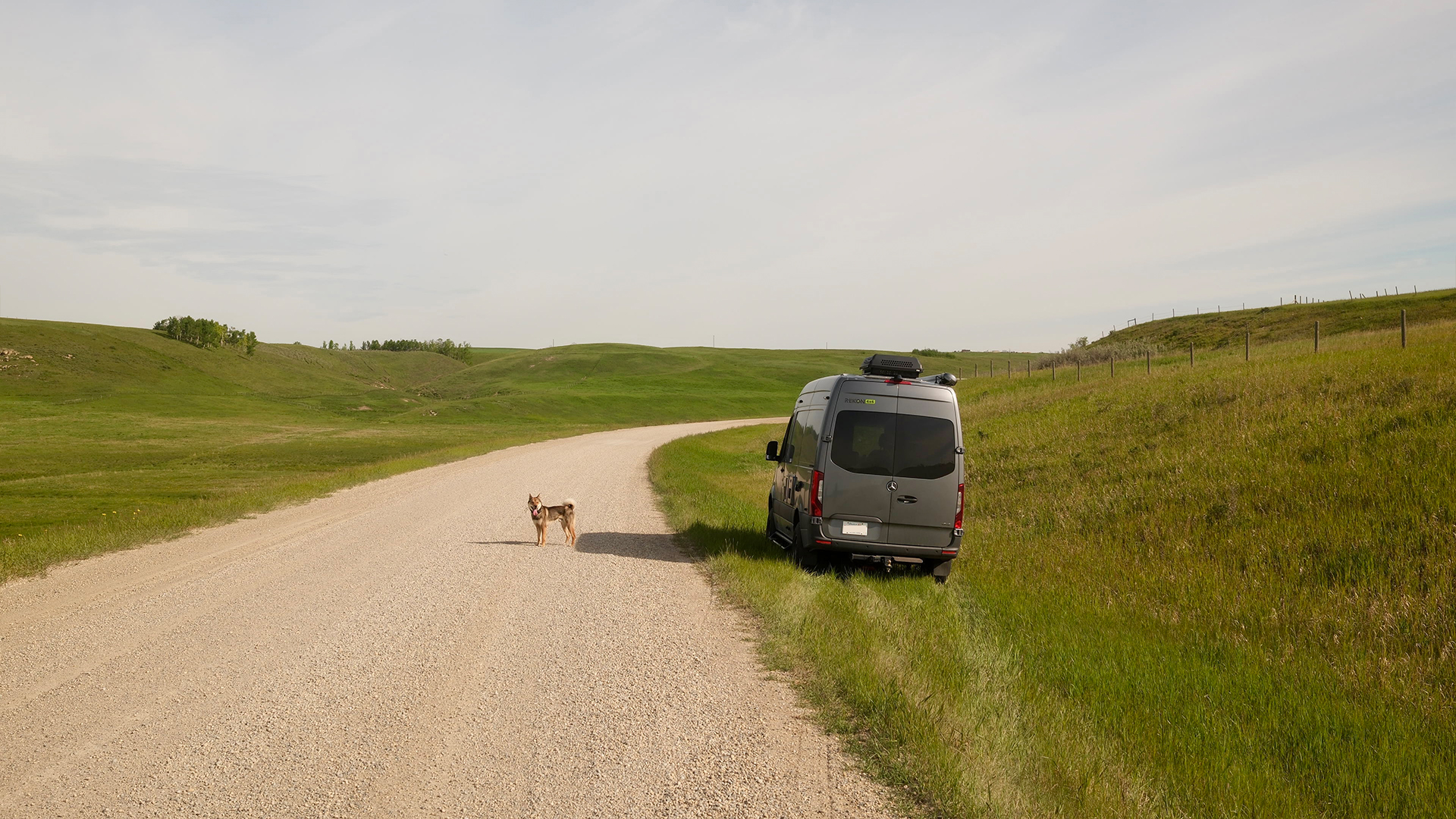
There is a particular kind of sound that settles in around kilometer 33,000 and six months on the road. It's not from the engine hum, the wind rattle, or the tires on the asphalt. It's a lingering feeling. The same one that greets me when I open my eyes certain mornings and the same one that will be waiting for me when we park tonight. That anxious feeling translates best into a question: Where am I going next?
I haven't read much into the vanlife lifestyle, or looked into the logistics of it before getting into it. (This is how we operate in life, I've noticed. Trent and I go apartment hunting. We only look at one and end up living there for two years. That's happened thrice. We want to do vanlife. We look at one van and it's the one for us. We buy it right away. Luckily I have Trent to lean on when it comes to these things. He heavily researches everything as part of his neurosis so I know I can trust whatever he thinks is right for us.) I ran on many years of experience being outdoors and camping most weekends. I thought it would be similar. But it isn't on all accounts. Camping is pre-planned. Set to a weekend or a week. You pack your essentials for that period of time and then you go home. Vanlife isn't like that.
Vanlife on social media emphasizes sunsets, destinations, freedom, the morning coffee with a view that changes every day. You're shown the time lapses of winding roads, set to a trendy audio and call it a life unbound. And it is, but it also isn't. I find it difficult, with only six months of experience so far, to not have an end destination. I chose this life, yet even with the most careful research, the true cost of every decision only reveals itself once you're already making it. I wanted mobility, wanted to trade my four apartment walls for four directions. But what I've discovered is that constantly being in motion is hard in ways I didn't anticipate.
What I'm living out is what you might call a mobility paradox. The freedom I sought has revealed its inverse truth: mobility sounds like freedom until you realize it's also a series of daily decisions with no endpoint. Every day begins with logistics: How far today? Which route? Where will I sleep? Is it legal to park there? Is it safe? Does the gas tank have enough? Does the battery have enough charge? Each question is small. Together, they accumulate into a kind of ambient stress that sits just beneath the surface of every scenic overlook and every roadside break.
Moving every day creates micro-decisions that compound, one after another after another, until the simple act of being somewhere starts to feel like work. Packing up. Driving. Arriving. Assessing. Setting up. Repeating. The cycle is seamless, and that's precisely what makes it exhausting. There's no friction to slow you down, no reason to stop, no structural excuse to say: We're here now. We're staying.
Because the thing is, I want to stay. Vanlife, ironically, has prompted me to want to stay somewhere for weeks at a time. To learn the name of a coffee shop. To walk the same trail twice and notice what's changed. To sit still long enough that a place starts to feel like it knows me, too.
There's a hunger for rootedness that I didn't expect, that crept in quietly when we were in a local Jasper coffee shop. I catch Trent lingering at campsites, delaying departure, inventing reasons to stay one more night. Prompting me to relax and ease into it. One more night could become two. Two becomes three. And then the question returns: Where am I going next?
It's a quiet negotiation between us, the part of me that needs movement and the part of me that craves stillness. Trent sees the invitation in the pause. I see the delay. And somewhere in that disagreement, there's a version of ourselves that both belongs on the road and doesn't quite know how to live there.
My anxious brain can't seem to find comfort yet with not having a final destination. I've unconsciously always operated in arcs. Goal, plan, execution, result. I measure progress by arrival. I find security in knowing where something ends. This is the sedentarist assumption I inherited without realizing it: the belief that value, expertise, and belonging are concentrated in fixed locations. Professional services operate this way, concentrating decision-making and knowledge in urban centers while treating mobility as a logistical problem rather than lived reality. I've been carrying that same logic into the open road, expecting stability from instability, permanence from impermanence.
Van life doesn't offer that. There is no finish line on the open road. No completion point where you set the keys down and say: We made it. Every arrival is temporary. Every parking spot is borrowed. Every beautiful view is a place you're passing through.
You can drive past places that take your breath away and leave them behind without ever seeing them again. The land feels like home, but it doesn't hold you the way a fixed address does. No lease. No neighbours. No sense that you're expected to stay.
This tension isn't unique to vanlife. It's the central challenge for anyone operating outside sedentarist frameworks. And I'm starting to see it in my work too. I struggle with the same questions whenever I approach a new project: How do you represent a place-based community? How do you move through places without extracting from them, without treating communities like waypoints rather than places worth staying in?
I didn't set out to study this stuff. But six months into this life, reflecting back on my past research in design humanism, it's starting to feel like the work I'm supposed to be exploring.
I've realized I can't just wait for the shift. I have to work at it. I can't wait for the question to no longer feel like a question, and I have to transform it into a gift. When "where am I going next?" becomes more exciting than anxious. When the openness transforms from void to opportunity. When the lack of a destination becomes the destination itself. This is a change in practice, of seeing place in a different way. One I can apply not only to myself but also to the work and services I provide to my design partners. If I'm asking myself to stay somewhere long enough to belong, I need to ask the same of how I move through their stories too.
Our mobile design practice, like my own mindset on the road, would require resisting quick-fix impulses toward genuinely transformative commitment. It means accepting that these opportunities (work-related or otherwise) demand slower timelines, deeper relationship building. That I can't just show up, extract what I need, and disappear. The work stays with me even after I've moved on.
Some parts of me will always lean into planning to curb my anxiety, always be looking for the marker at the end of the page. But I'm learning to hold both truths: that I'm built for structure, and that I chose chaos. That I need answers, and that I'm driving toward none.
The road never ends. Our next destination is British Columbia with the goal of visiting loved ones on Vancouver Island. With that goal in mind, there's always a version of this journey that hasn't resolved itself yet. Where will we camp along the way? How long will we spend where? The questions never end.


studiopumpo.com