
There's nothing between Edmonton and Hinton. A blog told me so when I searched for stops along the Yellowhead Highway. What a lie. But we're not looking for just any stop. We're driving to Jasper for a friend's wedding, and every mile brings us closer to the Rockies. I think some people don't know how to appreciate the prairies and their hidden gems, or perhaps they simply haven't looked hard enough. It takes a little Google Maps sleuthing, but I'm something of a pro now. Growing up with the internet at my fingertips, I developed a hobby of following roads on satellite view, wondering where they would lead. What landmarks hide here? What does that ocean coastline look like? Over the years, I've become practiced at localizing myself on maps, deciphering where to go next. When we leave Edmonton, the goal is straightforward: find a park-like area where we could pull over for work and for walking Soba.
Driving west, we stop at a highway rest stop along the Yellowhead for a Zoom meeting, but we press on and discover Pembina River Provincial Park. Not far from the highway, we cross a small town and enter a forested river valley. Stepping out of the van hits us with humidity. It has been unseasonably wet for what feels like the entire summer so far. We work all day stationed beside the river. The water churning brown with sediment, mosquitoes circling my head, laptop screen dimmed to save battery under the awning*.* Soba gets a proper walk too. He spots a beautiful white-tail deer, his dream snack, fortunately out of reach. Finding a provincial park like this, tucked into what seems like an insignificant stretch of highway, is a small pleasure. It makes me wonder how many provincial parks we have passed through without knowing it.
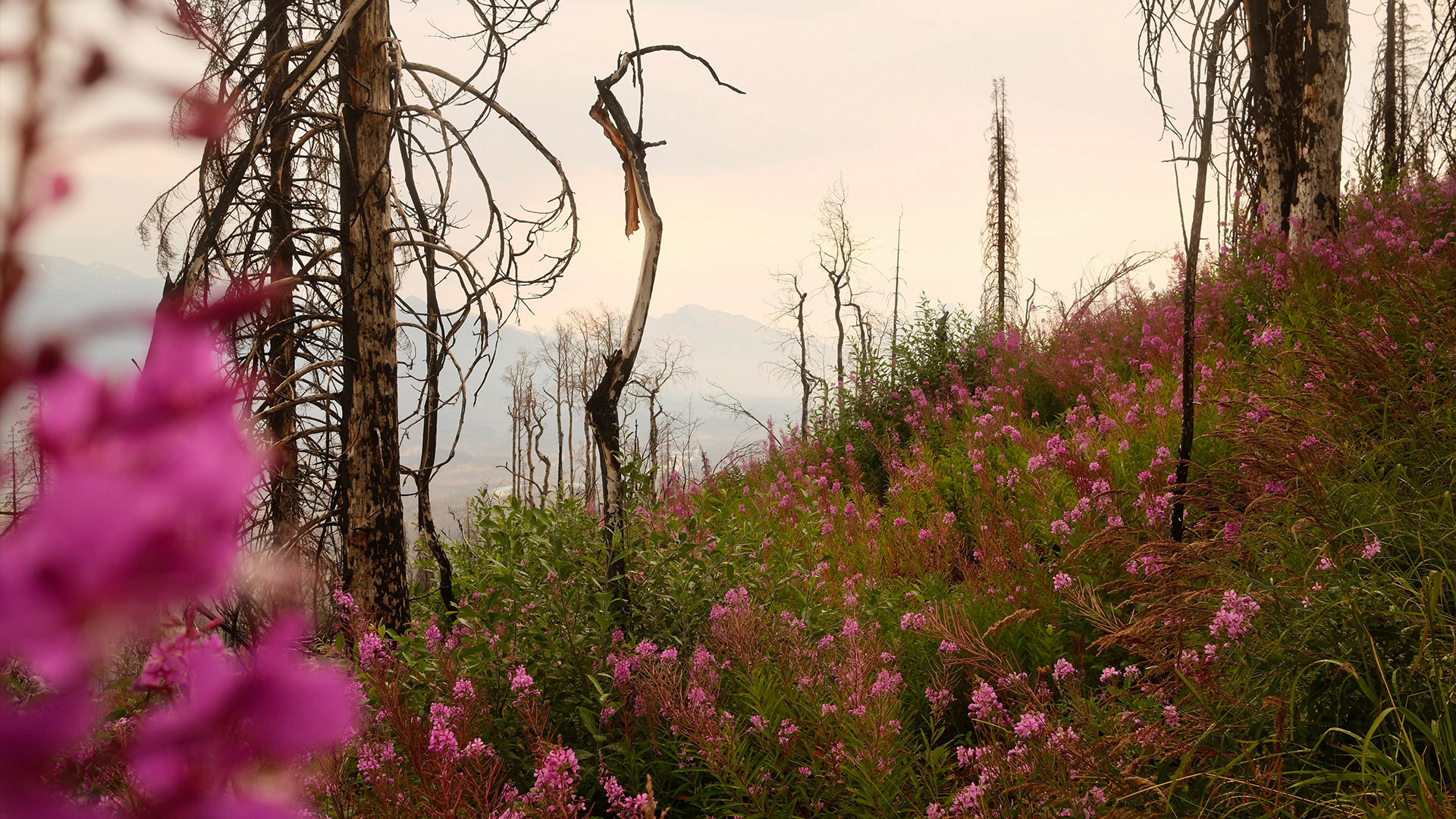
At the end of the day, we leave the flatlands behind as the foothills begin to rise in Hinton, the gateway to the Rockies, the staging ground before Jasper National Park. Located in the Athabasca River valley, Hinton is where we pause before reaching our campground reservation in Jasper. The campground was where we'd sleep before the wedding the next morning. Just north of the river lies the Athabasca Ranch Public Land, where we stay the night and the following workday. It is convenient having public land so close to a major stop along the Yellowhead. We do not have to drive far into the bush to find a scenic spot. Making our way to Jasper, I realize I have not been to the park since the fires. The landscape has changed. Compared to Waterton's fire a decade ago, Jasper has not had as much time to regrow. You can still see the effects. Burned trees stand like skeletal sentinels, fireweed carpets everything in violet, temporary trailer homes scattered for displaced locals. Yet there is beauty in the recovery. Nature insists on itself despite devastation.
The wedding is breathtaking. Incredible food (some really tasty bison sliders and bacon-wrapped scallops), wonderful company (met a bunch of cool new people), what a view (from the Jasper Park Lodge). And it would not be a wedding without a post-wedding hike. The next day, we climb to a rock ridge to celebrate the newly married couple (who are avid rock climbers and outdoor enthusiasts). The following morning arrives leisurely. We wake late, pack up from the campground, and head into town for supplies and a caffeine fix. We discover a local coffee shop and fall in love with their branded illustrations, so much so that we buy a t-shirt of Otto's Cache (this will prompt us to start a cafe t-shirt collection). They serve both matcha and hojicha on their menu, which convinces me to order. Cup in hand, we drive up to the Whistlers Peak trailhead.
The day before, my mom and I exchange relatively easy hike recommendations for the Jasper area. She suggests Five Lakes. I think of Whistlers Peak. I hiked it as a kid and want to return. What I don’t know is that the hike from my childhood memories is the 1.2 km trek from the skytram at the mountain's summit, not the trail from bottom to top. This is a trail I have never done, and perhaps not the best choice to begin at noon. Luckily it is summer, so the sun sets late, but I approach everything in life with the December mindset of daylight counting. 16.3 kilometers in distance, 1314 meters of elevation. I report these stats to Trent after checking the trailhead map. He is surprised. I had been advertising this as an easy hike.
Let's do it, Trent says in his typically optimistic tone, tightening the laces on his boots in commitment. Our Soba can handle any terrain, so we are not concerned for him. It is more about us. We have not attempted a hike with that kind of elevation in a long time, if ever. Pack the trail backpack, fill the water bottles, gear up Soba, grab the windbreakers, lace up the hiking boots. Ready. There are barely any cars in the gravel parking lot, a very different experience from climbing Sulphur Mountain in Banff. Part of my attraction to this peak is that it is the national park's gondola mountain, like Sulphur, so I expect a similar experience. But I am wrong. Sulphur hikes at a steady pace the whole way. On a good day, we can easily ascend in an hour.
As we hike Whistlers, we notice first that the vegetation is transformed. Having experienced a devastating wildfire two years prior, the trees are ravaged, yet nature has surged back in the form of long grass and tons of fireweed. The terrain is far from consistent. Up, flat, zig-zags, boulders, loose rock, dirt. Beautiful, though. Soba walks steadily, no rush on his end. Neither are we. It takes us three hours to make it up. Whistlers Peak gets its name from the marmots that inhabit its rocky summits. You hear them whistling at you as you climb. When we reach the top, Soba witnesses one, perhaps reminding him of his time in Montreal, staring at city park marmots. It activates something primal in him for the descent. He pulls the whole way back to the van, hoping to catch one. We are burnt after a two-hour hike down. Just under six hours total.
Banff faces on overtourism challenge. Too many cars on the highway, too many people lining the trails, too many signs pointing to popular viewpoints. Because of its proximity to Calgary, the park has been overrun by tourists seeking the same photo spots, the same experiences, the same sense of discovery that once belonged only to those willing to venture farther. In the last few years, I see a major shift in Banff National Park where I am no longer motivated to visit as much, whereas I was there almost every weekend as a child growing up in the suburbs of Calgary. Back then, the mountains felt like our backyard, a place where nature remained wild because it had space to breathe. Now, it feels curated, managed, packaged for consumption.
Jasper is different. It is still a tourist destination, but its distance from any major city creates a natural filter. People have to want it. They have to commit to the drive, to the time, to the journey itself. This does not take away from the experience. It actually enhances it. Fewer cars in the parking lots at Whistlers Peak means more quiet moments on the trail. More fireweed in the regrowth zones means fewer footsteps crushing the recovery. The silence here is precious.
The view from the summit is worth it, but I have never been someone who enjoys hiking motivated by reaching the top. I enjoy being hugged by nature and its trees, whispered flowers, and feeling the high of a little exercise. The views are just a bonus. The mountains here feel bigger than what we are used to, big domes, peaks stacked upon peaks, snow lingering in midsummer. Next, we point the van southward. The Icefields Parkway stretches ahead, and after today, I know enough to expect nothing and everything at once.


studiopumpo.com